Posts

Showing posts with the label Wednesday Words

Wednesday Words- Impulse Control

Image
 Wednesday Words We will look at the words that define us.   If you have spent much time teaching young children you have heard of impulse control, but what is it?    First let's look at the brain: source The main part of the brain that is in control during the act of stopping to think actions through is the frontal lobe.  As stated in an article by the Livestrong Foundation, found here , Higher-level thinking is supported by the frontal lobes. Activity in these lobes allows us to reason, make judgments, make plans for the near and far future, make choices, take action, solve problems and generally control our living environment. Without fully functioning frontal lobes, you may have intelligence, but you wouldn’t be able to put it to use. The quote mentions "fully functioning" frontal lobes. When do they become "fully functioning?"  I'm glad you asked..... around the mid-twenties.  Although, I'm sure many of us have met those roug...
Wednesday Words- Number Sense

Image
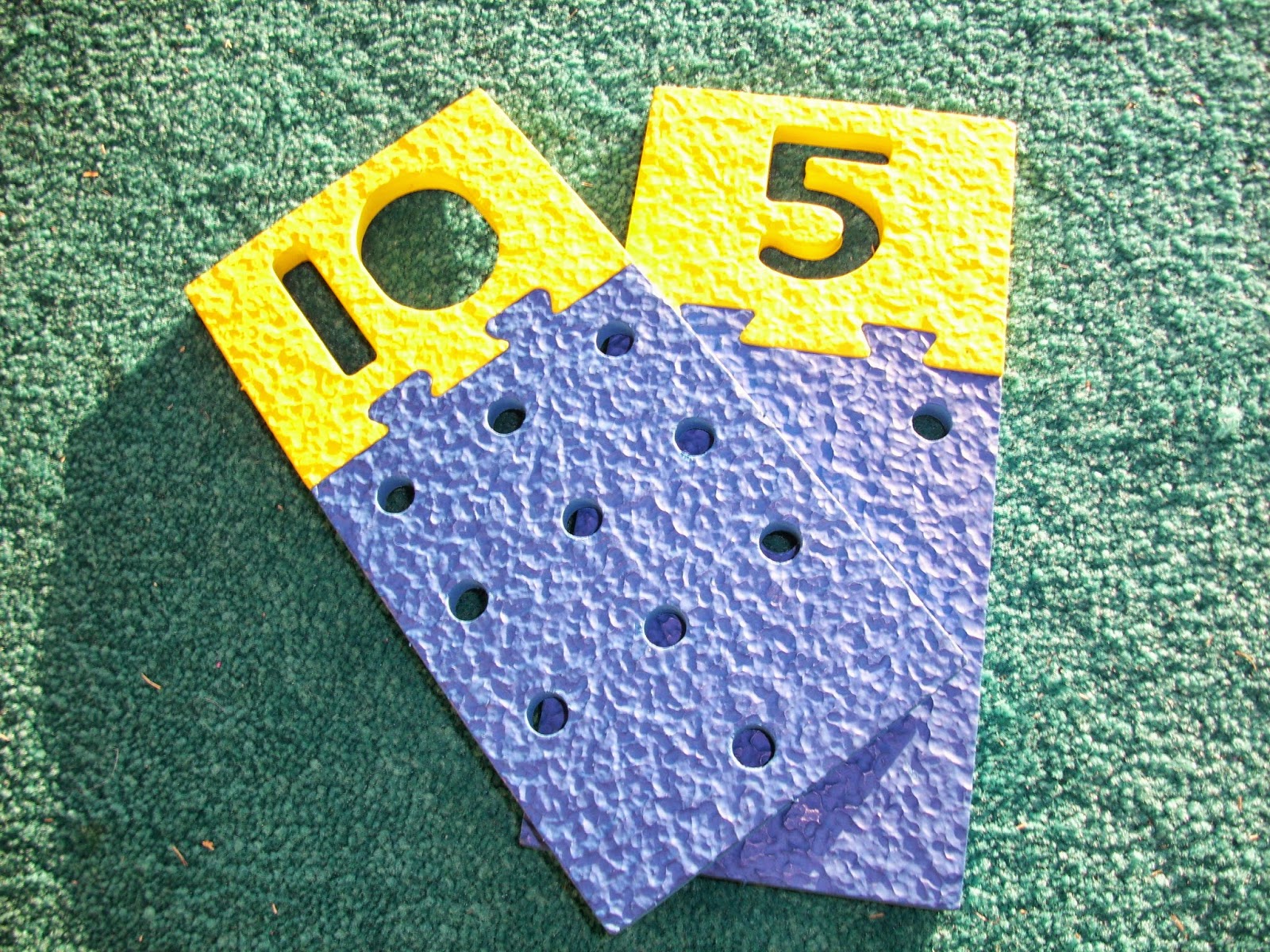
Wednesday Words We will look at the words that define us. Number sense. Does that term make sense to you? Enough with the word play already, lets define! Number sense simply refers to the ability to understand and use numbers.  This is not a topic that is taught in one lesson, instead think of it as an ongoing process that is taught directly and indirectly.  When children are young and we ask them to pass out the appropriate number of snack materials we are working on number sense.  When we ask them to identify numbers we are working on number sense.  When we ask them to show us a set identifying a specific number we are working on number sense. When we ask them what digits make up a larger number we are working on number sense. Do you see a trend here? The idea is that when children are exposed to and allowed to explore numbers and quantities from a young age (I'm talking infants here!), they develop the ability to manipulate numbers on a deeper s...

Wednesday Words- Phonemic Awareness

Wednesday Words We will look at the words that define us. Have you ever wondered what phonemic awareness means?  It is a term used much more frequently in preschool and early elementary levels, but it has roots in infancy. First things first- what is a phoneme?  A phoneme is the smallest unit of sound in a given language.  Phonemic awareness then would be defined as the ability to hear, identify, manipulate, and use these sound units.  This is so important as children learn to read and write.  How can you assist your child or students in gaining phonemic awareness?  Simple!  One of the biggest things is TALKING!  Just talking to your infant constantly is important.  This will be how they first become aware of various sounds and how they fit into language. You can also play rhyming games, sing songs, and read to your child.  In the classroom you can also incorporate games where you change or manipulate sounds within known word...

Wednesday Words- ECERS

Image
Wednesday Words We will look at the words that define us.   First let me apologize.  I know it is Thursday and I am just now posting for Wednesday.  We had our Kindergarten graduation today so I was at school late setting up.  Like 10:30 pm late.  It was worth it!  Everything turned out beautifully! Now onto the regularly scheduled programming... Today we are looking at another acronym, ECERS.  Have you heard of ECERS before? I hadn't heard about it until I started working in an early childcare setting and a coworker introduced it to me.    ECERS stands for the "Early Childhood Environment Rating Scale."  The University of North Carolina Chapel Hill Frank Porter Graham Child Development Institute lists the major needs that a childcare setting must provide for as: Protection of their health and safety Building positive relationships Opportunities for stimulation and learning from experience  Source   ...

Wednesday Words- NAEYC

Wednesday Words We will look at the words that define us.   Have you ever found that store, restaurant, or whatever that you just love and want to share with everyone?  I feel that way about NAEYC! So what is it?  The National Association for the Education of Young Children.  There are so many resources put out by this group that you should have their webpage bookmarked.  Don't know their webpage?  Here it is http://www.naeyc.org/ So what can they do for you?  There are so many benefits to being a member. Here is a short list: Discounted books. FREE books and journals sent to your home. Automatic membership into state and local affiliates. Discount admission to conferences. Our local affiliate here puts on continuing education classes a few times a year for FREE for members.  They also have a yearly conference. Personally I love that they have created a standard of excellence for early childhood educators.  Centers (even hom...

Wednesday Words- Scaffolding

Image
Wednesday Words We will look at the words that define us.   Last week we looked at the “zone of proximal development” and I promised we would address scaffolding this week. Have you heard this term before?   It is one I use quite a bit, especially when describe how to adjust lessons to meet the needs of all the children in my room. Scaffolding refers to the assistance given to children to allow them to achieve more than they could independently. Scaffolding is what occurs within the ZPD to move the child forward.   Why call it scaffolding? If you think about it, it makes sense.  A scaffold is something that helps you get into place to work. Scaffolding instruction helps children get into place to learn.   An example of this would be to ask a child leading questions while they are exploring materials.   If you have given a child shape pieces and asked them to put the pieces together in a specific shape you can ask many questions about the sh...

Wednesday Words- ZPD

Image
Wednesday Words We will look at the words that define us.   Do you ever hear an acronym and have no idea what it means? There are many acronyms thrown around in education and sometimes their meaning can become lost or overlooked.   One such acronym is ZPD. Any idea what that means?   ZPD stands for "zone of proximal development."   This is a term that was developed by Lev Vygotsky.   Vygotsky is a psychologist and developmentalist who strongly believed in social learning.   He looked at the way that interactions with others aided the child in learning. Essentially the ZPD is the area where a child can learn through interactions with others more than they can learn independently.   This area of possible learning is referred to as the ZPD.   When creating lessons think about ways to stretch a child's learning by providing assistance through peers and instructors.   Often times we equate ZPD with scaffolding.   ZPD is act...

Wednesday Words- Correlation

Wednesday Words We will look at the words that define us.   Chances are if you have read any research studies or even reviews of studies you have heard the word correlation.   Correlation is one of those words that can get us in trouble if we overlook its meaning. Correlation simply means that there is some sort of relationship between two things.   This DOES NOT mean that one thing causes another, only that they relate in some way.   Dictionary.com puts it this way: " mutual relation of two or more things, parts, etc.: Studies find a positive correlation between severity of illness and nutritional status of the patients. Synonyms: similarity, correspondence, matching; parallelism, equivalence; interdependence, interrelationship, interconnection. " When reading a study that shows a correlation between two items try to remember that this really only tells us that further study is needed to understand how the two topics rel...

Wednesday Words- DAP

Wednesday Words Where each week we will look at the words that define us.     DAP- Developmentally Appropriate Practice.   This is a term you will hear frequently in early childhood education.   This term means that the actions you are taking are within the appropriate developmental range for the children in your care.   The National Association for the Education of Young Children (NAEYC) wrote a position statement on DAP in 1987 after noticing the trickle of expectations to younger children that is inappropriate for their developmental level. NAEYC set forth to establish these guidelines and continue to reevaluate them for those in the early childhood field. You can find out more about your specific age group and their expectations by searching the NAEYC website.  http://www.naeyc.org/ How does this influence your classroom?   With each action you take in your room you should evaluate whether it is DAP or not.   While this sounds li...